

Image
a group of yellow flowers growing in a rocky field
Topics

Mental Health in Colorado: Are Things Really Getting Better?

May 11, 2026

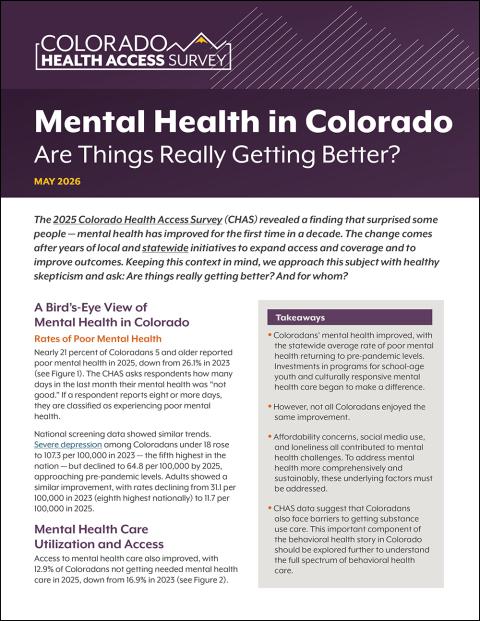
The 2025 Colorado Health Access Survey (CHAS) revealed a finding that surprised some people — mental health has improved for the first time in a decade. The change comes after years of local and statewide initiatives to expand access and coverage and to improve outcomes. Keeping this context in mind, we approach this subject with healthy skepticism and ask: Are things really getting better? And for whom?

A Bird’s-Eye View of  Mental Health in Colorado 

Nearly 21 percent of Coloradans 5 and older reported poor mental health in 2025, down from 26.1% in 2023 (see Figure 1). The CHAS asks respondents how many days in the last month their mental health was “not good.” If a respondent reports eight or more days, they are classified as experiencing poor mental health.

Identifying Progress: Getting Care to People With the Greatest Needs 

Mental health improvements were not equally distributed across populations and communities. The following sections examine where progress was most apparent — and where gaps remained.

Age 

Improvements in mental health were most apparent for adults ages 30 to 64 (see Figure 2). However, for other age groups, including young adults and older adults, rates of poor mental health appeared to hold steady following years of worsening mental health. According to the CHAS, access problems for Coloradans age 5 to 17 halved, with only 8.0% of Colorado youth unable to get needed mental health care in the past year (see Figure 3). These access improvements are especially pronounced for middle and high school age youth, who went from 21.0% reporting access issues in 2023 to 7.5% in 2025. 

Following growing investment in programs for school-age youth, supply for needed mental health support and resources may be catching up to demand. However, young adults ages 18 to 24 still experienced high rates of poor mental health and access issues. This suggests that Colorado does not have adequate mental health support for people entering adulthood — a vulnerable time when many young people transition away from supportive school or home environments they may have relied on.

Gender 

In 2025, both women and men showed improvements in mental health, although only men showed a statistically significant improvement (see Figure 4). 

Rates of poor mental health for men and women began to diverge in 2017, with rates increasing rapidly for women between 2017 and 2021. Men had a slower increase in poor mental health, but the numbers kept worsening through 2023. This suggests that rates of poor mental health for men may have primarily been driven by the COVID-19 pandemic, and thus improved when the pandemic subsided. But women’s mental health challenges were driven by other factors that intensified well before COVID. While the pandemic amplified women’s mental health challenges, as the pandemic ended, rates of poor mental health did not decrease at the same rate as they did for men. Additionally, while access to care has improved for both men and women, women were also still more likely to report access issues, with 14.4% unable to get needed mental health care compared with 10.0% of men in 2025.


This is an abbreviated version of the report. For the full analysis — including data on mental health trends by race/ethnicity, systemic drivers of poor mental health, and barriers to care — please open the full PDF.